
Insights
Native Citrus: Finger Lime Propagation Challenges and Solutions
August 2024 • 7 min read
The Australian finger lime (Citrus australasica) has captured international attention for its unique "citrus caviar" fruit structure. As global demand grows, understanding the species' propagation biology becomes essential for growers seeking to scale production.

The Monoembryonic Challenge
Unlike many commercially important citrus species, finger limes are monoembryonic. This term describes the embryo development pattern in citrus seeds and has significant implications for propagation.
In polyembryonic citrus (like many oranges and mandarins), seeds contain multiple embryos—typically one sexual embryo plus several nucellar embryos that are genetically identical to the mother plant. Growers can plant seeds and expect most seedlings to be true-to-type clones.
Finger limes, however, produce seeds with only a single, sexually-derived embryo. Each seedling is a unique genetic individual, combining traits from both parent plants in unpredictable ways. For a grower who has identified or selected a variety with desirable characteristics—optimal pearl formation, particular flesh colour, superior flavour—seed propagation simply won't reproduce those traits reliably.
Why Monoembryony Matters
- • Each seed produces a genetically unique plant
- • Fruit characteristics vary unpredictably among seedlings
- • Selected varieties cannot be reproduced from seed
- • Commercial production requires vegetative propagation
Conventional Propagation Limitations
Vegetative propagation—reproducing plants from non-seed plant parts—ensures genetic identity. However, conventional vegetative methods present their own challenges for finger limes.
Cutting Propagation
Finger limes can be propagated from semi-hardwood cuttings, but success rates vary and the process is relatively slow. Building commercial quantities of plants through cutting propagation requires significant mother plant material, time, and infrastructure.
Grafting
Grafting onto compatible rootstocks is another option, but multiplication rates remain limited by the availability of scion material. Each graft produces only one new plant, creating constraints when large numbers are required.
Tissue Culture Approaches
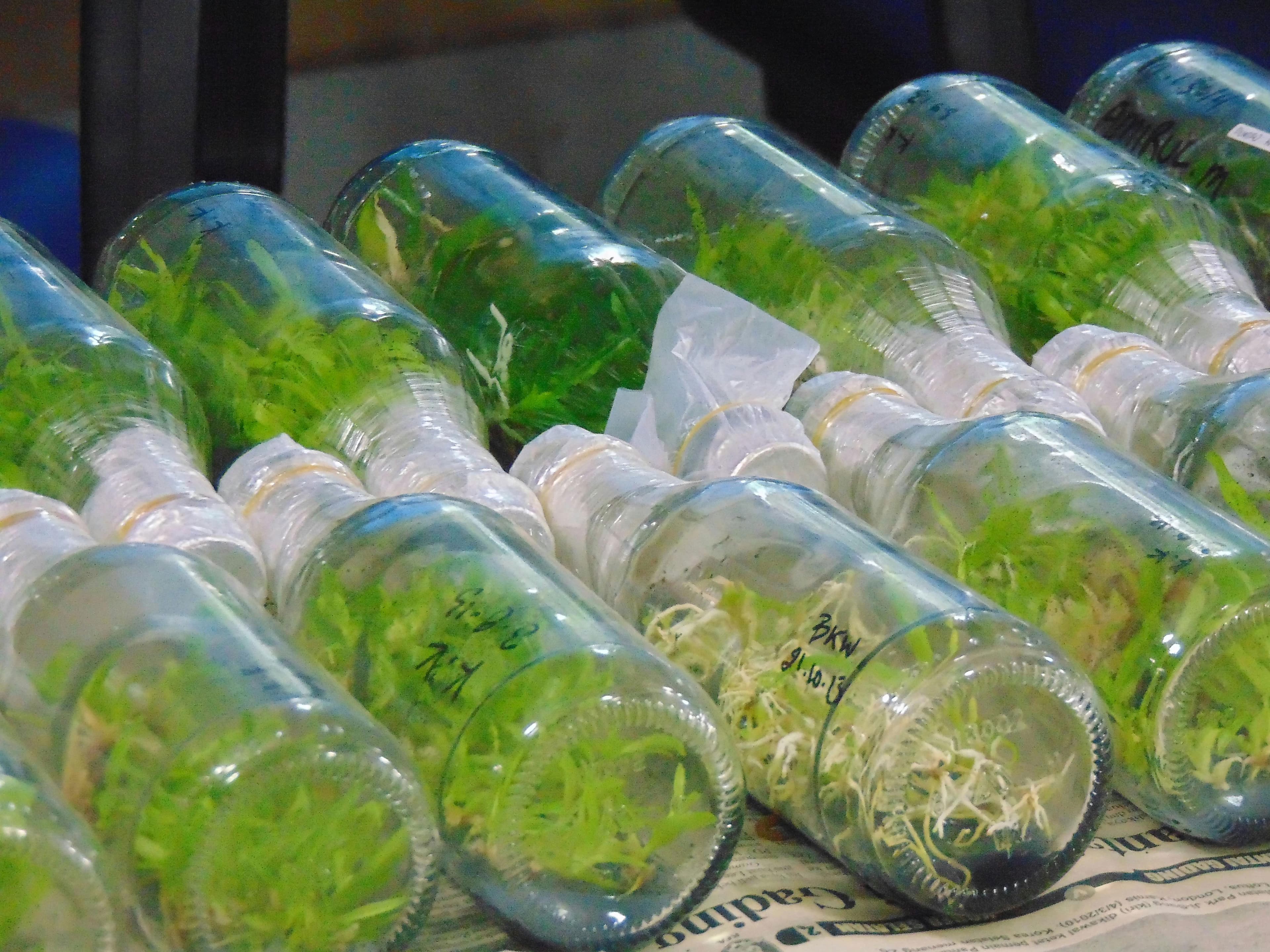
Tissue culture provides an alternative that addresses both the genetic fidelity requirement and the scale challenge. Research has established effective protocols for finger lime micropropagation.
Established Protocols
Published research describes successful finger lime tissue culture using Murashige and Skoog (MS) medium supplemented with appropriate growth regulators. Cytokinin compounds like BAP (6-benzylaminopurine) promote shoot multiplication, while GA3 (gibberellic acid) supports shoot elongation.
One challenge specific to Australian native citrus is leaf abscission—the tendency for leaves to drop during culture. Research has shown that silver thiosulfate (STS) treatments can help prevent this problem, improving multiplication rates and culture success.
Benefits for Growers
- True-to-type propagation: Every plant exactly matches the selected mother plant—same flesh colour, pearl formation, and flavour.
- Disease-free stock: Laboratory conditions exclude pathogens, providing clean starting material.
- Scale: Multiplication rates far exceed conventional methods, enabling commercial quantities from limited mother stock.
- Variety preservation: Elite selections, breeding lines, and rare variants can be maintained and multiplied.
Market Context
The commercial case for finger lime tissue culture reflects growing market demand. International prices of $40-50 per pound for quality fruit have attracted grower interest, while restaurants and food manufacturers continue to seek supply of this uniquely Australian ingredient.
For growers, variety selection matters significantly. The market recognises different flesh colours—green, pink, red—and pearl characteristics. Tissue culture enables growers to establish orchards of known, selected varieties rather than the genetic lottery of seedling plantings.
Looking Forward
University research programs continue to develop and refine finger lime tissue culture protocols, with focus on mass production of elite breeding lines. As the industry matures, tissue culture will likely become an increasingly standard component of commercial nursery operations.
For growers planning new finger lime orchards or seeking to propagate superior selections, tissue culture provides the technical pathway to quality, scale, and consistency.
Learn More
For more on the finger lime industry and the tissue culture work we're interested in:
Australian Finger Lime Industry Page →Need Finger Lime Plants?
Finger lime is one of the native crops we're interested in. If you're working with it, we'd be glad to start a conversation.